Client Overview
Client Overview
A global intelligence business built around high-value content and data
The platform brings together specialist research, market data, product experiences and access to expertise for professional audiences around the world. But when the platform foundation, brand experiences and marketing handoffs were not fully connected, customers faced more friction finding value and client teams had to work harder to manage the relationship.
ENGAGEMENT PROFILE
| Engagement profile | Detail |
|---|---|
| Industry context | Global market intelligence and information services |
| Customer experience |
Public research, product discovery, registrations, events and interactive data |
| Experience platform |
Sitecore XP 10.4.1 with Solr Cloud, analytics, forms and connected services |
| Marketing ecosystem |
Oracle Eloqua and Salesforce Marketing Cloud |
| Operating model |
Editorial, product, marketing and technology teams working across a live publishing estate |
Why the platform mattered
Why the platform mattered
The digital estate connected public content discovery with registrations, product journeys and access to interactive market data. Editorial, product, marketing and technology teams therefore depended on the same platform changes succeeding together.
This made the engagement broader than a CMS upgrade. Sitecore, search, forms, analytics, acquired content, the interactive data product and campaign automation all had to be modernized without breaking the live customer experience.
Executive Summary
Executive Summary
The platform’s specialist research, market data and analyst expertise are most valuable when customers can find and act on them quickly. An ageing platform foundation, separate brand experiences and disconnected handoffs between content and campaigns made that journey harder to manage and improve.
YenDigital worked with the client across platform engineering, content operations, search, analytics, forms and marketing automation. The team modernized the legacy Sitecore estate, brought acquired content and the interactive data product into one unified platform, and most recently upgraded the unified estate to Sitecore XP 10.4.1. Oracle Eloqua and Salesforce Marketing Cloud were connected to the web experience to support measurable customer journeys.
KEY OUTCOMES AT A GLANCE
The Challenge
The Challenge
Valuable insight was spread across disconnected digital journeys
The client needed to modernize a live Sitecore estate, consolidate an acquired website and the interactive data product, and connect customer behavior to marketing follow-up without interrupting publishing, search, forms or access to specialist content.
Where the digital estate was creating friction
-
An ageing platform foundation
- Sitecore had to be modernized without disrupting publishing, search, forms or customer journeys.
-
Separate brand experiences
- The acquired business operated its own website, content estate and interactive data experience while the unified estate had its own platform and information architecture.
-
Complex migration dependencies
- Content, assets, metadata, URLs, search indexes, integrations and customer actions all had to move together.
-
Content-to-campaign handoffs
- Website activity needed to connect cleanly with marketing automation so valuable interest did not stop at the page view.
-
Enterprise governance
- Global teams needed reliable workflows, permissions, multilingual support, controlled releases and production support.
Current state and target direction
Current state and target direction
- Acquired and platform content managed across separate brand experiences.
- Research and product content presented through one unified experience.
- The interactive data product operated within the acquired digital estate.
- The interactive data product was brought into the unified platform alongside related content and journeys.
- Older Sitecore versions carried legacy components and dependencies.
- Sitecore XP 10.4.1 provides the current platform foundation.
- Web, analytics and campaign activity required more coordination.
- Sitecore, Oracle Eloqua and Salesforce Marketing Cloud support connected, measurable customer journeys.
YenDigital Transformation Journey
YenDigital Transformation Journey
Modernizing without putting live customer journeys at risk
A single large replacement would have put publishing, search, integrations and customer journeys at unnecessary risk. YenDigital therefore delivered the transformation as a sequence of controlled changes, with each phase solving an immediate problem and creating the foundation for the next.
1. Establish a modern experience foundation
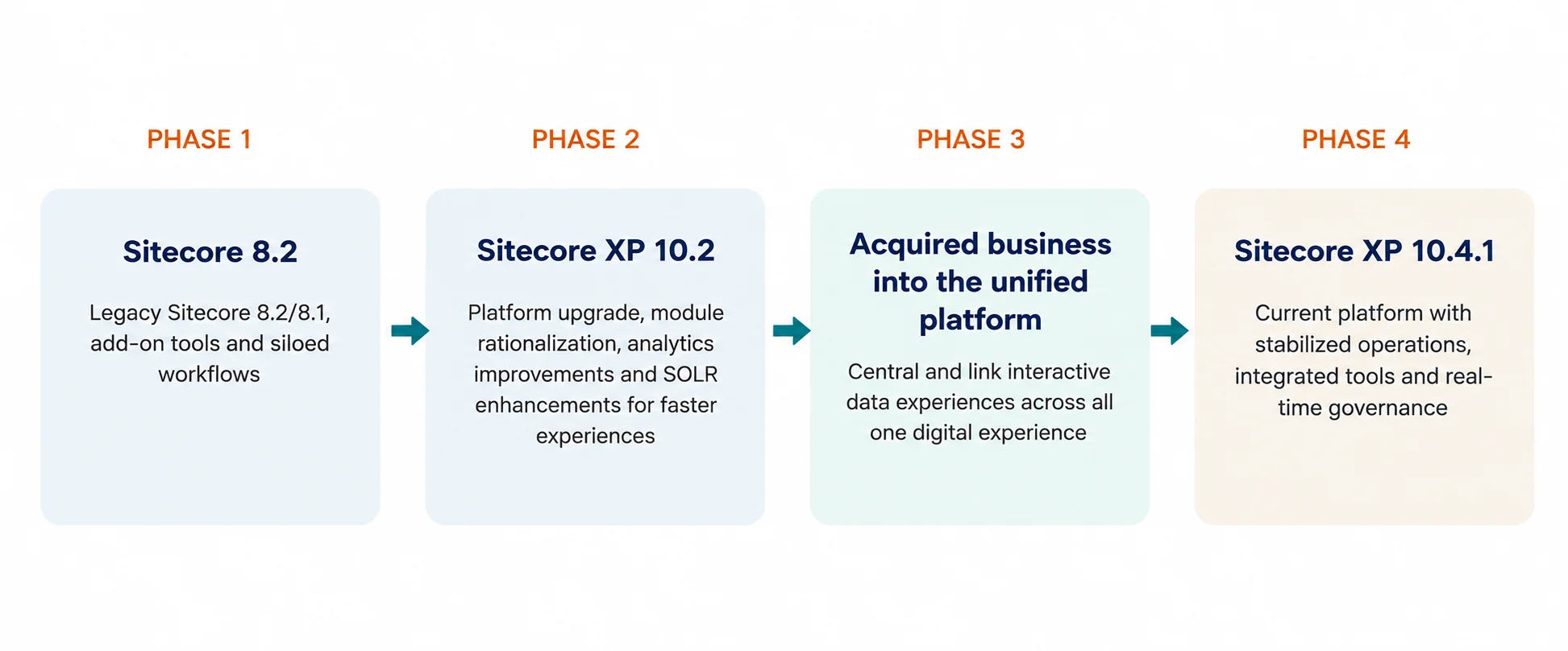
The legacy Sitecore 8.2 estate limited how the experience could evolve. YenDigital upgraded it to Sitecore XP 10.2 and redesigned the experience around clearer discovery and stronger digital engagement.
- Migrated or rebuilt legacy applications and custom functionality.
- Moved WFFM implementations to Sitecore Forms.
- Modernized analytics and upgraded Solr search capabilities.
2. Consolidate the acquired business into the unified platform
The acquired business still operated as a separate digital estate. YenDigital brought its website content and the interactive data product into the platform, creating one platform and one customer-facing experience.
- Mapped content types, taxonomies, product structures and customer journeys.
- Integrated the interactive data product and related content into the platform’s information architecture.
- Protected discoverability through redirect, search and metadata planning.
3. Upgrade to Sitecore XP 10.4.1.
YenDigital has recently upgraded the platform to Sitecore XP 10.4.1, bringing the unified estate onto a current, supportable foundation. The team validated custom components, integrations, forms, analytics, search, publishing and customer journeys across the consolidated platform, preparing the estate for ongoing optimization.
Acquired Business Migration
Acquired Business Migration
Moving an acquired business without separating content from interactive data
The acquired business’s specialist content and the interactive data product were closely connected, but they sat within a separate digital estate. Treating the migration as a simple page move would have broken the relationship between research, product information, market data and customer actions. YenDigital instead rebuilt that complete experience inside the platform.
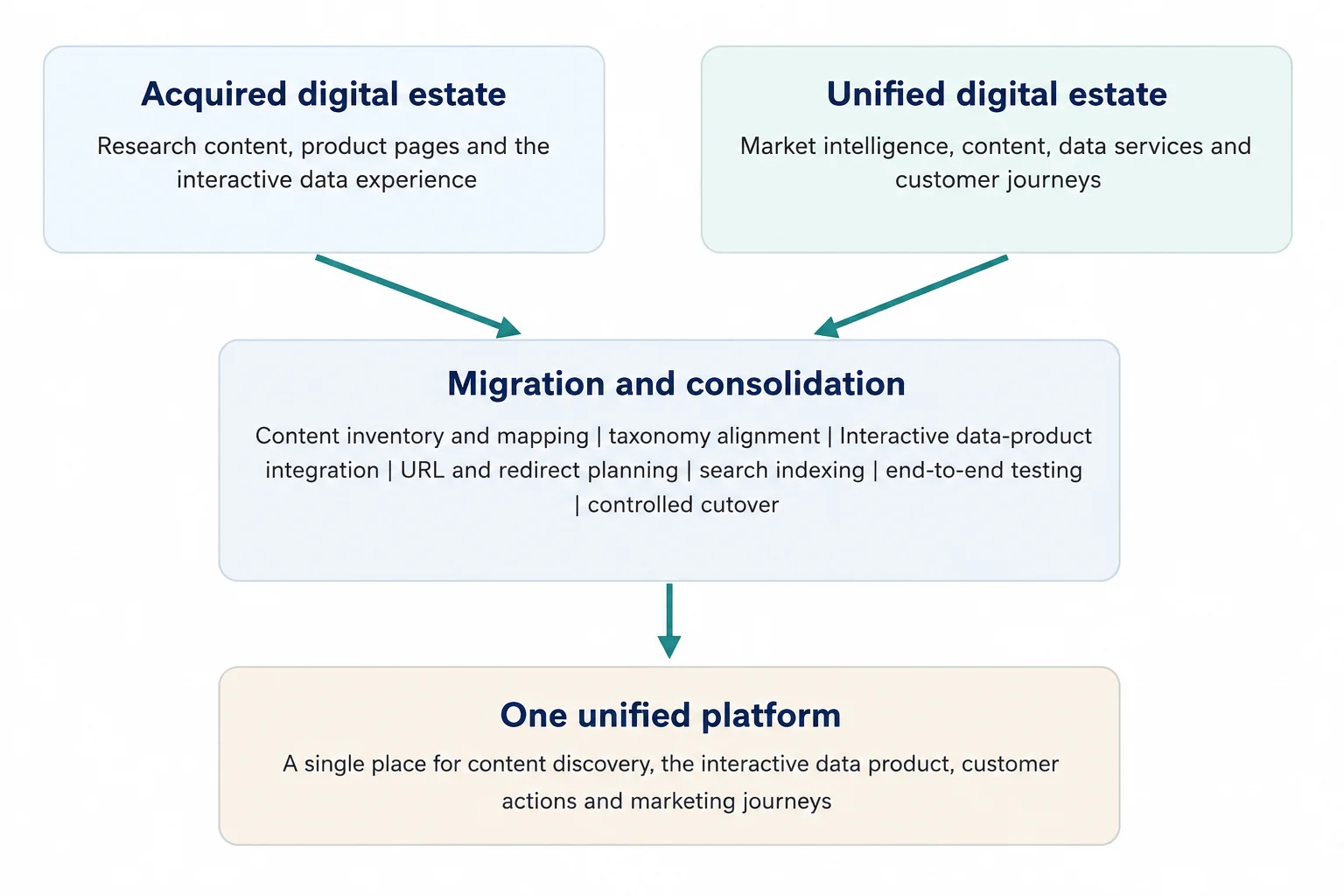
How YenDigital solved the migration challenge
- Content and asset inventory. YenDigital identified pages, research content, product information, media, ownership and publishing status before migration.
- Information architecture and taxonomy. The team mapped acquired-business topics, products and metadata into the platform so users could browse and search consistently.
- Interactive data-product integration. YenDigital brought the interactive data experience into the platform while preserving the routes between data and related content.
- URL, redirect and search planning. The team protected working links, reduced dead ends and directed users and search engines to the correct the platform destinations.
- Validation, launch and support. YenDigital tested content, search, forms, analytics, entitlements, integrations and customer journeys, coordinated cutover and closely.
Target State Architecture
Target State Architecture
One connected platform, not another layer of isolated tools
Bringing the acquired business into the unified platform solved the brand separation, but the experience would still feel fragmented if content, search, data and marketing operated independently. YenDigital connected these capabilities around Sitecore XP 10.4.1, with Solr supporting discovery, interactive data product providing market data, analytics revealing behavior, and Oracle Eloqua and Salesforce Marketing Cloud continuing the journey.
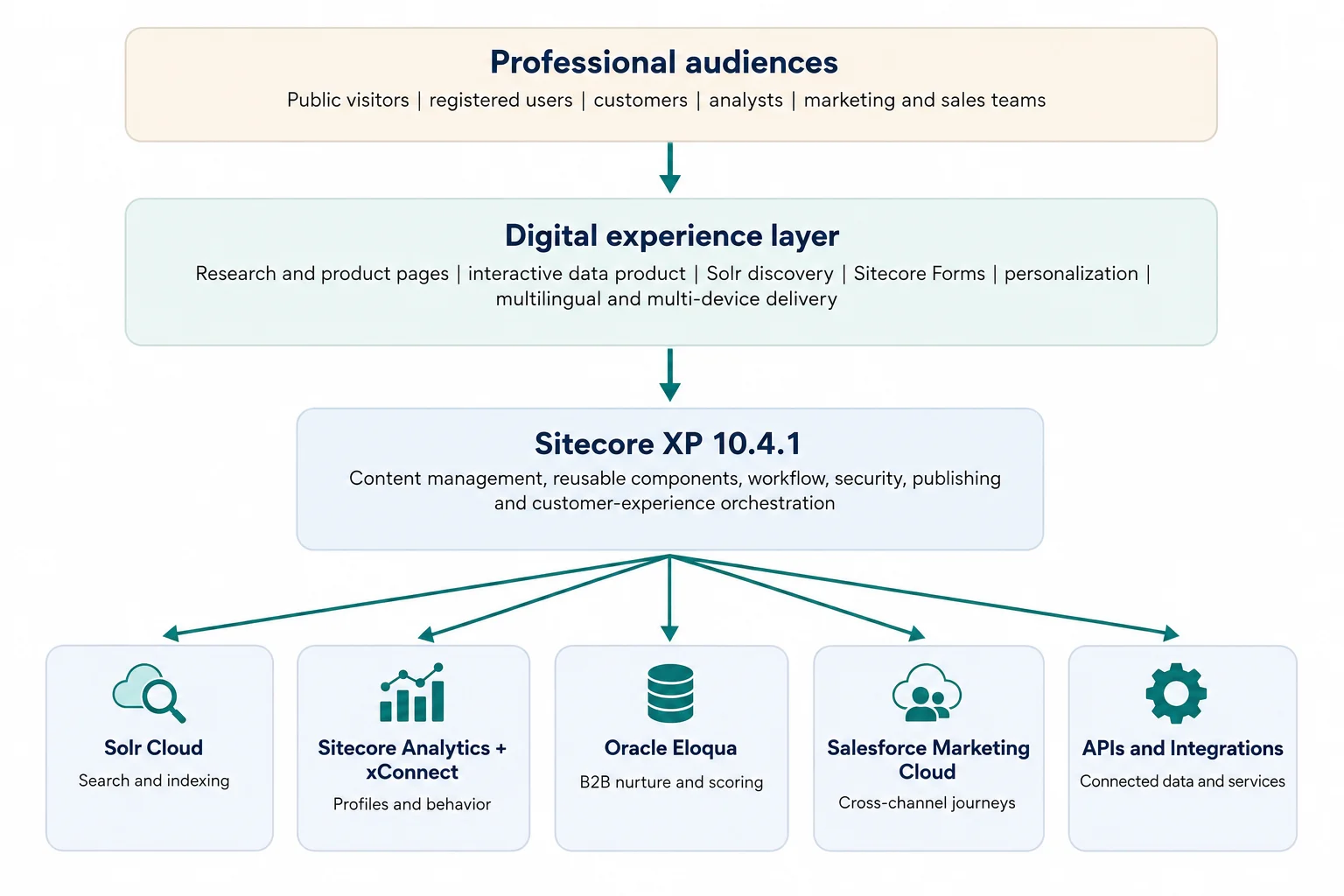
Unified Platform Architecture
Unified Platform Architecture
Giving each platform a clear job in the customer journey
Adding more technology would not solve the problem unless every platform had a clear responsibility. YenDigital defined how Sitecore, interactive data product, Solr, analytics, Oracle Eloqua and Salesforce Marketing Cloud work together, reducing gaps between the website experience and what happens next.
| Platform or capability | Role in the customer experience |
|---|---|
| Sitecore XP 10.4.1 | Core content, experience and publishing platform |
| Sitecore Forms | Registration, enquiry and customer-data capture |
| Sitecore Marketing Automation + EXM |
On-site journeys, campaign triggers and email capabilities |
| Sitecore Analytics, xConnect, Path Analyzer |
Behavior, profiles, goals and journey insight |
| Solr Cloud |
Search, indexing and content discovery |
| Oracle Eloqua | Segmentation, nurture, campaign orchestration, lead scoring and reporting |
| Salesforce Marketing Cloud |
Journey Builder, audience activation, automated communications and campaign reporting |
| Interactive data product |
Interactive access to market data within the unified experience |
What YenDigital Delivered
What YenDigital Delivered
How YenDigital addressed the platform and migration challenges
- Sitecore architecture and 10.4.1 upgrade. YenDigital planned and implemented the recent Sitecore XP 10.4.1 upgrade across the unified platform. In practice: Reviewed dependencies and customizations; upgraded the solution; validated templates, components, forms, search, analytics and integrations; coordinated safe deployment.
- Acquired-content migration. Content from the acquired website was mapped and moved into the unified platform while maintaining the structure needed for publishing and discovery. In practice: Inventoried pages and assets; aligned content types and metadata; migrated content; implemented redirects; completed editorial and technical checks.
- Interactive data-product integration. The acquired business’s interactive data experience was brought into the unified platform so data and related research could be accessed within one customer journey. In practice: Mapped entry points and dependencies; integrated the experience; aligned navigation and product context; validated access, performance and related journeys.
- User experience and content discovery. The public experience was redesigned and continually improved to make specialist product and research information easier to find and act on. In practice: Reusable components and templates; responsive and multilingual delivery; landing pages; calls to action; personalization; automated publishing.
Delivery Workstreams
Delivery Workstreams
Solving the handoff between experience, data and marketing
- Search and indexing. Search was modernized to support fast, dependable discovery across an expanding content and product estate. In practice: Solr upgrades and indexing changes; taxonomy-aware discovery; migration validation; result checks; monitoring and issue resolution.
- Forms, analytics and personalization. Sitecore Forms, goals, engagement values, Experience Profile and Path Analyzer were used to connect visitor actions with more relevant experiences. In practice: Profile and demographic capture; activity-based goals; journey analysis; personalization rules; engagement measurement; controlled data handling.
- Oracle Eloqua, Salesforce Marketing Cloud and automation. YenDigital supported the connection between the platform’s web experience, Oracle Eloqua and Salesforce Marketing Cloud so interest in specialist content could progress into structured, measurable marketing journeys. In practice: Eloqua segmentation, Campaign Canvas, nurture and lead scoring; Salesforce Journey Builder, Automation Studio, audience activation and campaign reporting; integration and operational support.
- Governance, security and production support. The platform was operated as a business-critical service with controlled workflows and ongoing collaboration across editorial, marketing, product and technical teams. In practice: Author roles and permissions; publishing workflow; release management; monitoring; incident resolution; performance tuning; continuous improvement.
Marketing and experience tools used across the program
- Content and experience. Sitecore XP 10.4.1, Sitecore Forms, Media Library, workflow, automated publishing and personalization.
- Insight and optimization. Sitecore Analytics, xConnect, Experience Profile, Path Analyzer, goals, engagement value and Cortex capabilities.
- Search and data experience. Solr Cloud, interactive data product and supporting APIs and integrations.
- Campaign activation. Oracle Eloqua, Salesforce Marketing Cloud, Sitecore Marketing Automation and EXM.
End-to-End Customer Journey
End-to-End Customer Journey
Stopping valuable customer interest from ending at a page view
A visitor may show clear interest in a report, product or dataset, but that value is lost if the signal remains inside the website. YenDigital connected Sitecore with Oracle Eloqua and Salesforce Marketing Cloud so the client could understand the original context and continue the relationship with the right audience, message, channel and timing.
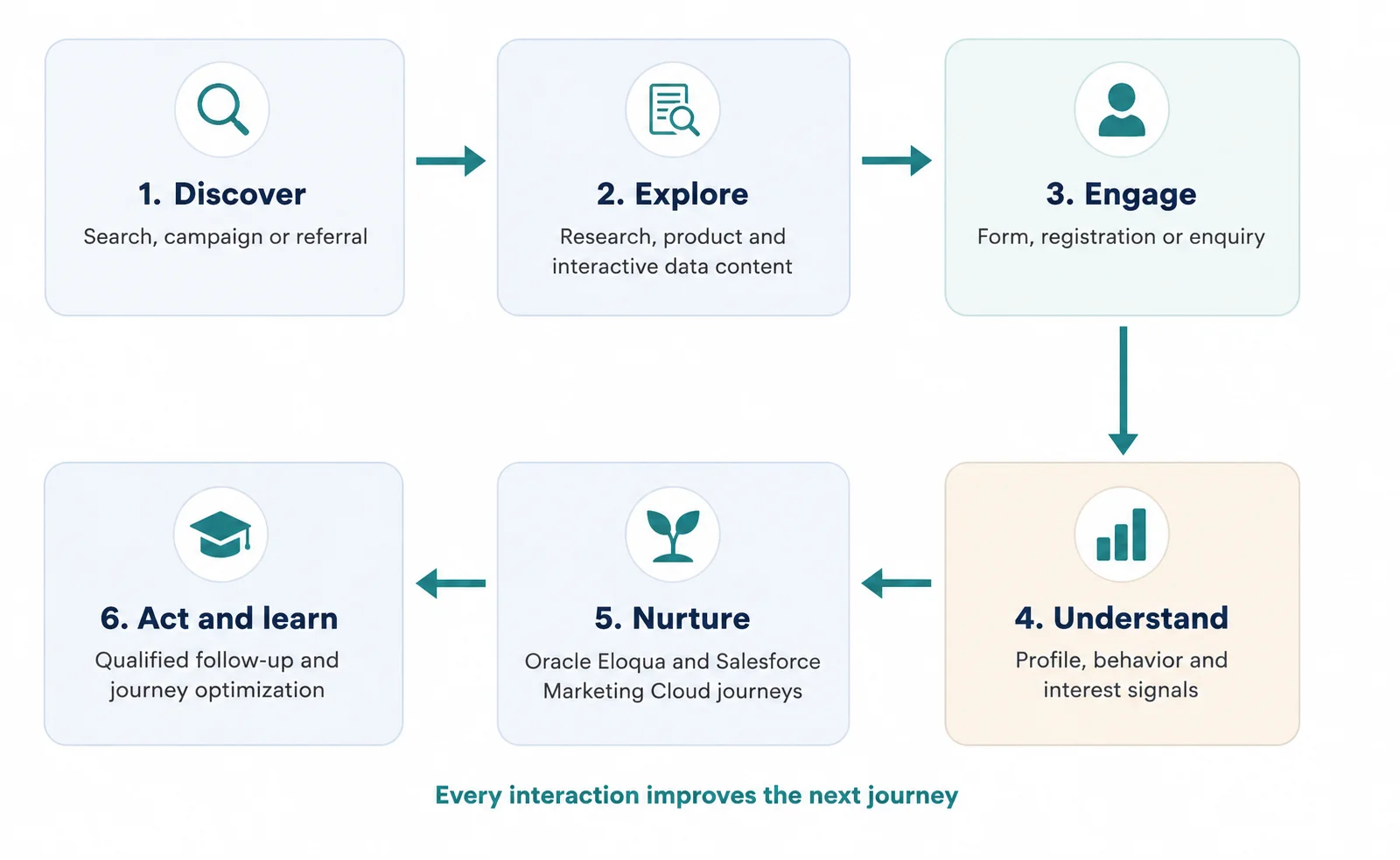
How YenDigital used Oracle Eloqua and Salesforce Marketing Cloud
- Audience segmentation and activation. Organize and activate audiences by product interest, topic, behavior, role, region or agreed profile information.
- B2B nurture and qualification. Use Eloqua Campaign Canvas, nurture programs and lead scoring to progress and prioritize specialist B2B interest.
- Cross-channel journey orchestration. Use Salesforce Journey Builder and Automation Studio to coordinate timely, repeatable communications across customer touchpoints.
- Campaign consistency. Reuse approved templates, content, data structures and campaign patterns across teams while retaining local relevance.
- Reporting and learning. Review Eloqua and Marketing Cloud campaign performance alongside Sitecore journey data to improve the next experience.
Connected Marketing Journeys
Connected Marketing Journeys
Connecting the website signal to the next useful action
Without a defined handoff, website behavior becomes another disconnected data point. YenDigital designed the flow around real customer actions: capture the signal, preserve its context, trigger the appropriate response and retain enough visibility to improve what happens next.
| Journey moment | Sitecore role | Marketing automation role | Value |
|---|---|---|---|
| Research published |
Sitecore publishes approved content and updates the shared experience. | Oracle Eloqua and Salesforce Marketing Cloud activate the relevant audience or campaign workflow. |
Faster, coordinated promotion. |
| Visitor explores content |
Goals and analytics capture topic and product interest. |
Engagement signals inform segmentation and nurture across the marketing platforms. | More relevant follow-up. |
| Form or registration |
Sitecore Forms captures and validates agreed profile data. |
The appropriate marketing platform updates the contact and starts the response. |
Cleaner data and quicker acknowledgement. |
| Nurture journey |
The website provides the next useful content destination. |
Eloqua Campaign Canvas and Marketing Cloud Journey Builder manage multi-step engagement. |
Consistent engagement at scale. |
| Qualified interest |
Content and data-product activity provide engagement context. |
Profile and engagement scores support prioritization and routing. | Timely follow-up from the right team. |
| Performance review |
Sitecore shows on-site journeys and content behavior. |
Eloqua and Marketing Cloud reporting show response, progression and campaign performance. |
A shared view of what to improve. |
Applied Marketing Automation Use Cases
Applied Marketing Automation Use Cases
Making marketing automation useful in real customer moments
Marketing tools alone do not create a better customer experience. Value appears when the platform responds usefully to a real action, such as reading research, using an interactive data product, registering for an event or returning after inactivity. YenDigital used Sitecore to preserve that context, then routed the journey through Eloqua or Salesforce Marketing Cloud according to the audience and required follow-up.
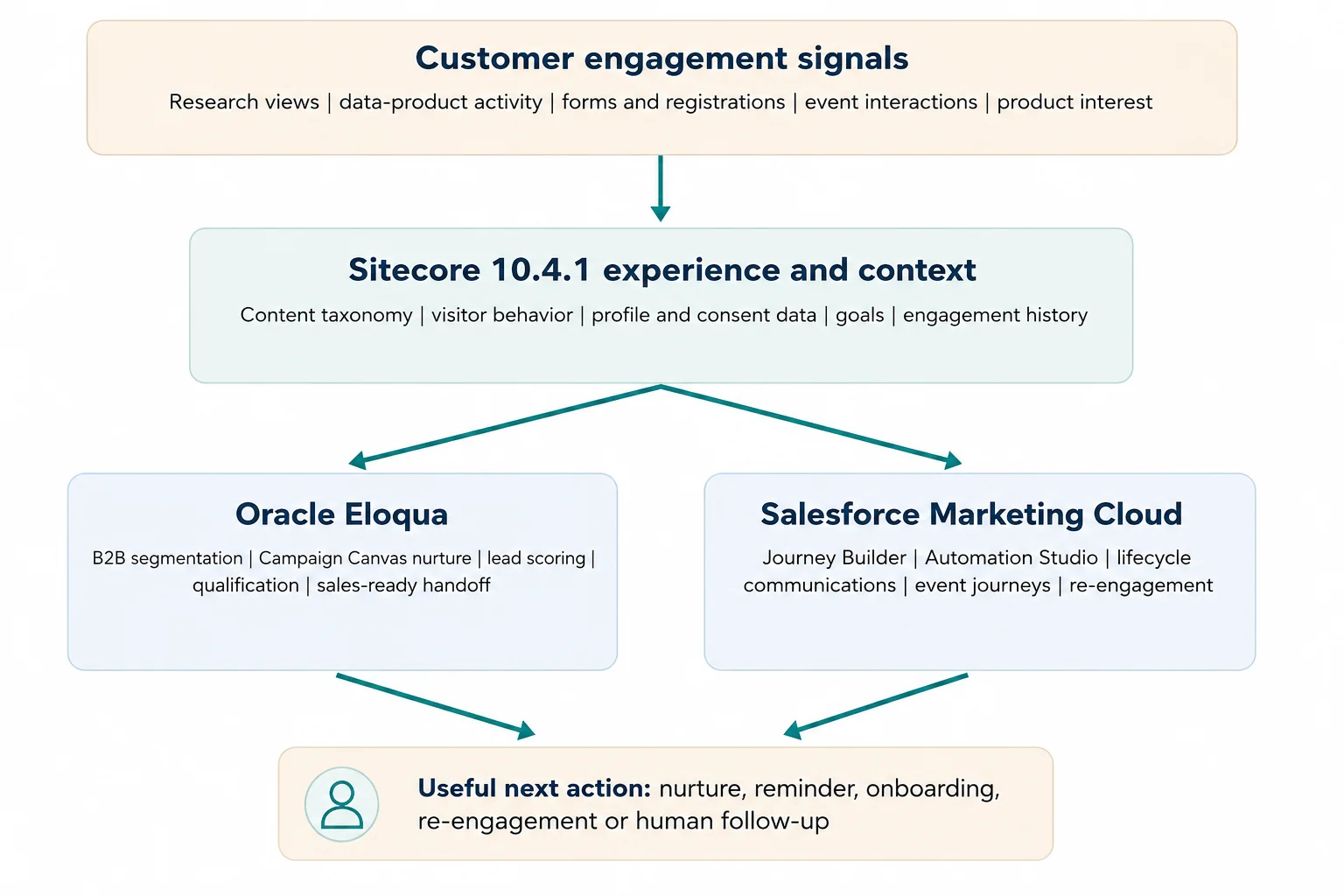
Choosing the right automation path
- Use Eloqua for B2B progression. Campaign Canvas, segmentation and lead scoring support longer consideration cycles, gated research nurture and sales-ready handoffs.
- Use Salesforce Marketing Cloud for lifecycle orchestration. Journey Builder and Automation Studio support event communications, onboarding, reminders, re-engagement and other timed customer journeys.
- Keep Sitecore at the center of context. Content taxonomy, forms, goals, behavior and the interactive data product entry points make the follow-up relevant to what the customer actually explored.
Gated Research Interest
Gated Research Interest
Turning a high-value report into qualified B2B interest
A form submission by itself tells the commercial team very little. A technology buyer may have explored a specific article, analyst insight or product page before requesting research or submitting an enquiry. YenDigital’s journey keeps that topic, product and behavioral context attached to the response so follow-up starts from a real customer need.
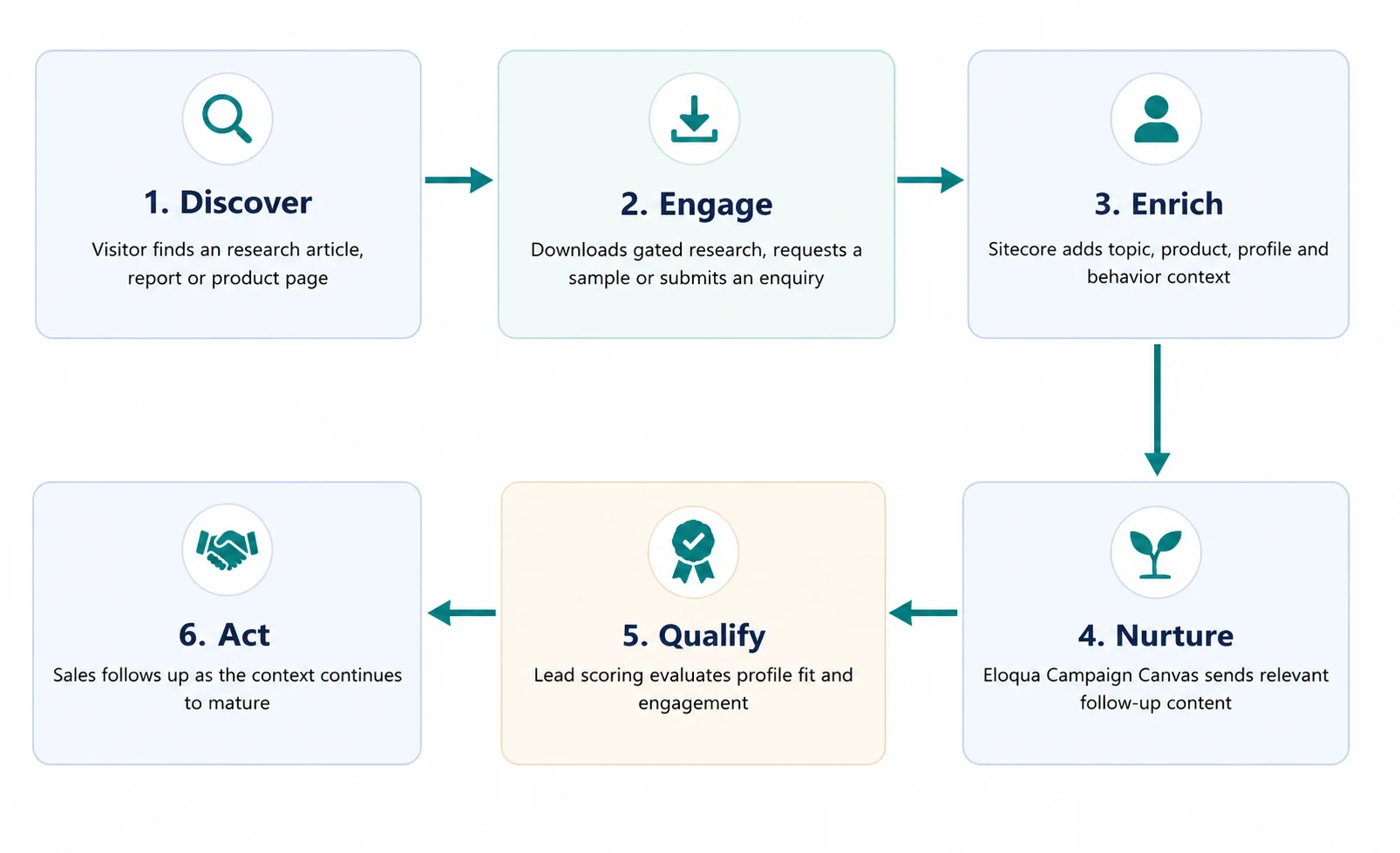
How the use case works in practice
- Capture the right context. Sitecore Forms captures agreed profile information while analytics and taxonomy identify the subject, product and journey that created the interest.
- Start a relevant nurture. Eloqua places the contact into a topic- or product-based Campaign Canvas and delivers related analyst content instead of a generic sequence.
- Respond to behavior. Additional report views, return visits, email engagement or a demo request can change the next message and increase the engagement score.
- Create a controlled handoff. When profile fit and engagement reach the agreed threshold, the appropriate sales or account team receives a clear reason for follow-up.
Webinar & Event Lifecycle
Webinar & Event Lifecycle
Keeping the event journey connected before and after the live session
Event communications often become a set of disconnected reminders and generic follow-ups. YenDigital connected the Sitecore registration experience with Salesforce Marketing Cloud so confirmations, reminders and post-event messages respond to the customer’s registration and attendance status.
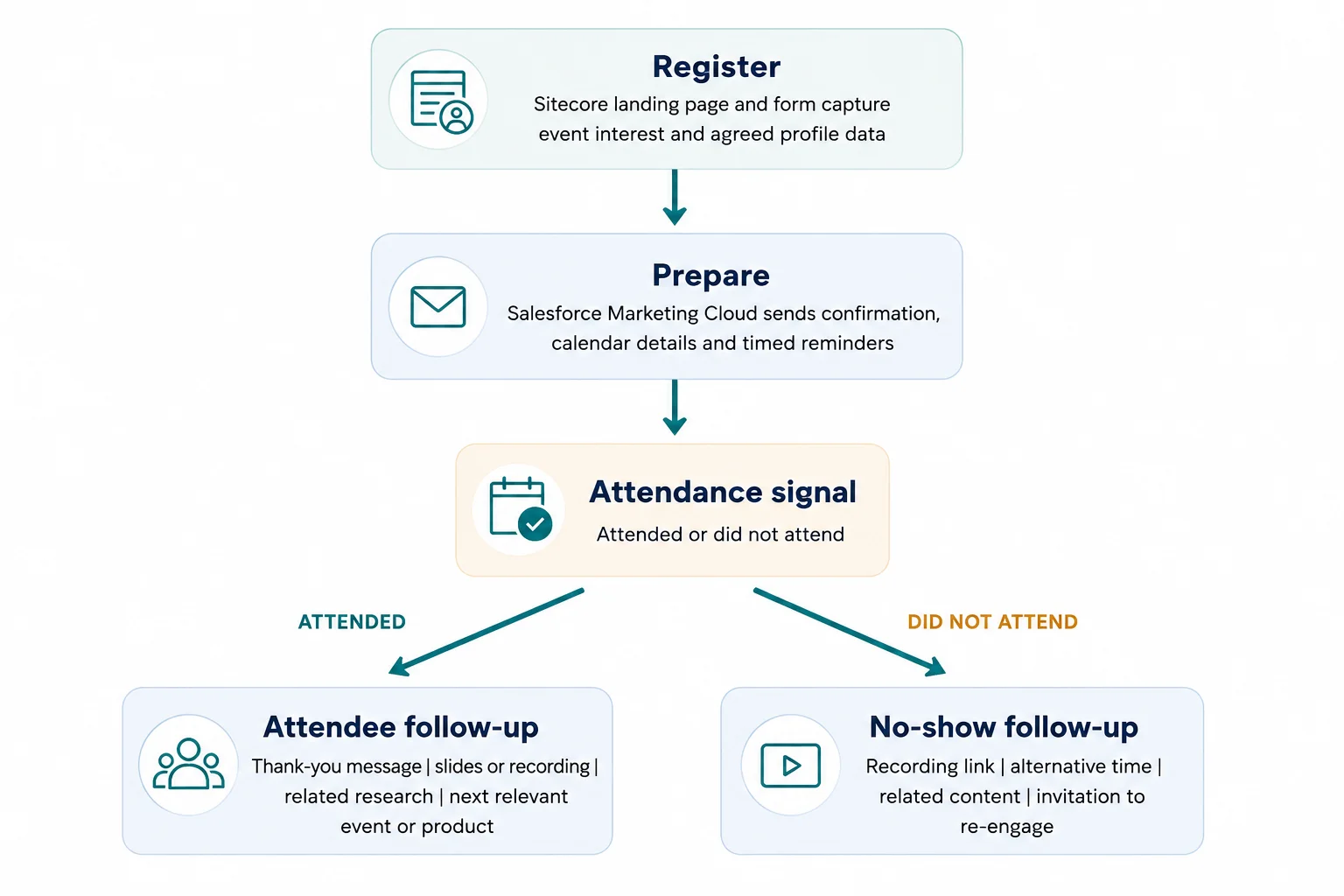
How the use case works in practice
- Before the event. Registration triggers confirmation, calendar details and scheduled reminders while suppressing duplicate or unnecessary messages.
- At the attendance decision. Journey Builder branches the audience using attended and did-not-attend status rather than sending the same follow-up to everyone.
- After the event. Attendees receive the promised materials and connected research; no-shows receive the recording or an alternative way to engage.
- Continue the relationship. Clicks, return visits and new registrations can route the contact to another event, a relevant content journey or human follow-up.
Interactive Data Journeys
Interactive Data Journeys
Use case 3: Turning data-product interest into informed follow-up
When the interactive data product sat within the acquired business’s separate digital estate, product interest and the wider customer journey were harder to connect. After the migration, YenDigital could link data-product activity with surrounding research, product context and marketing follow-up inside one experience.
- Recognize product intent. An interactive data product registration, demo request, enquiry or repeated exploration provides stronger intent than a single article view.
- Add research context. Sitecore identifies the topics and product pages explored before and after the interactive data product interaction.
- Nurture toward the next decision. Eloqua can deliver relevant use cases, analyst insights, product information or a demo path based on the demonstrated interest.
- Support informed follow-up. Commercial teams receive a clearer picture of the product area and content that mattered to the customer.
Use case 4: Helping customers reach value and re-engage
New users can struggle to discover the most useful features, while inactive users can be overwhelmed by generic messaging. YenDigital used Salesforce Marketing Cloud to structure onboarding and re-engagement around product access, interests and customer behavior, with clear exit and escalation rules.
- Welcome and orient. Journey Builder can introduce access, preferences, saved content, alerts and the first useful actions inside the platform.
- Encourage adoption. Follow-up can highlight relevant research, interactive data capabilities, events or features based on the user’s product and topic interests.
- Re-engage carefully. An inactive user can receive a short sequence built around recent interests, with exit rules when the user returns, responds or opts out.
- Escalate when needed. High-value engagement or repeated access issues can route to customer success, support or an account team instead of continuing automated messages.
Marketing Automation Playbook
Marketing Automation Playbook
A repeatable response to common customer situations
Individual campaigns become difficult to scale when every team solves the same journey differently. YenDigital established a repeatable operating model: start with a meaningful signal, preserve the content or product context, apply the right automation platform and finish with a useful next action.
| Use case | Customer signal | Primary platforms | Automated response |
|---|---|---|---|
| Research launch and gated download |
Report page, form completion or sample request |
Sitecore + Oracle Eloqua |
Segment by topic and product, start relevant nurture, score engagement and route qualified interest. |
| Webinar or virtual event |
Registration and attendance status |
Sitecore + Salesforce Marketing Cloud |
Send confirmation and reminders, branch by attendance, then deliver the recording, related research and next action. |
| Interactive data-product interest |
Repeated exploration, registration, demo request or enquiry |
Interactive data product + Sitecore + Oracle Eloqua |
Combine product context with profile fit, nurture toward a demo and notify the appropriate commercial team. |
| Customer onboarding |
New registration, subscription or product access |
Sitecore + Salesforce Marketing Cloud |
Welcome the user, explain access, encourage first-use actions and recommend relevant content or data. |
| Dormant-user re-engagement |
Reduced visits, inactive profile or limited campaign response |
Sitecore Analytics + Salesforce Marketing Cloud |
Use recent interests for a restrained re-engagement journey and stop when the user returns or opts out. |
| Cross-sell and topic expansion |
Strong engagement with adjacent topics or products |
Sitecore + Oracle Eloqua or Salesforce Marketing Cloud |
Recommend connected research or product experiences and route the contact into the appropriate program. |
Marketing Measurement & Governance
Marketing Measurement & Governance
Measuring customer progress, not only email activity
Email opens and clicks show campaign activity, but not whether a customer found value or moved closer to a decision. YenDigital framed measurement across Sitecore behavior, data-product activity, forms, events, automation progression and commercial follow-up so teams could review the complete journey.
| Measurement area | What teams can review |
|---|---|
| Experience engagement | Searches, content views, data-product activity, return visits, calls to action and high-value page sequences. |
| Acquisition and profile quality |
Form completion, registrations, usable profile fields, preference capture and consent status. |
| Journey progression |
Message delivery, clicks, completed steps, event attendance, return-to-site behavior and re-engagement. |
| Qualification and handoff |
Lead-score movement, marketing qualification, enquiries, demo requests and accepted follow-up. |
| Operational health |
Data synchronization, duplicate suppression, failed sends, workflow completion and campaign processing. |
| Continuous learning |
Drop-off points, content contribution, audience response and the next journey or content improvement. |
Controls that keep automation trustworthy
Controls that keep automation trustworthy
- Consent and preferences. Use agreed profile data, preference rules, suppression lists and unsubscribe handling consistently across journeys.
- Data quality and identity. Validate required fields, reduce duplicates and monitor integration failures before they affect segmentation or follow-up.
- Frequency and exit rules. Prevent contacts from receiving overlapping programs, and stop or change a journey when the customer acts.
- Content and brand governance. Reuse approved templates, campaign patterns, content blocks and regional variations with clear ownership.
- Human review and escalation. Keep commercial, customer-success and support teams involved where the next action needs judgment rather than another automated message.
Migration & Delivery Lifecycle
Migration & Delivery Lifecycle
Changing a live platform without losing control
The platform could not pause while Sitecore was upgraded and the acquired business was consolidated into the platform. YenDigital used a staged delivery model that kept business owners, editors, product teams, marketing and engineering aligned, with clear validation before each change moved forward.
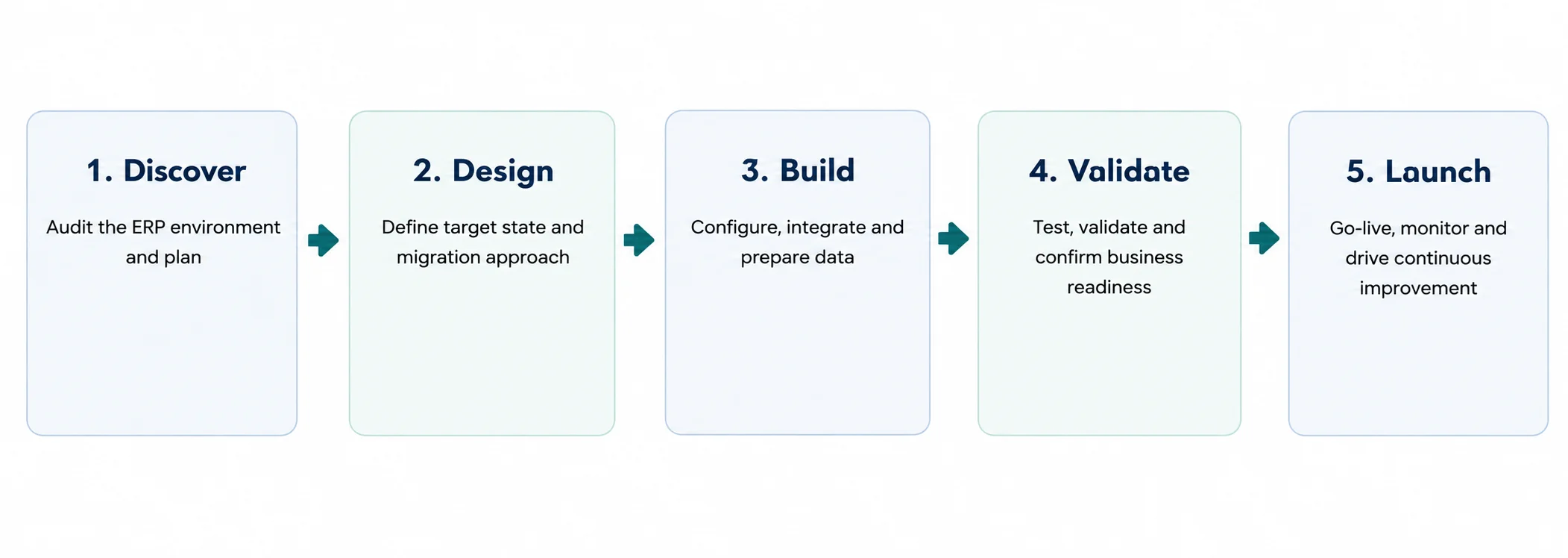
Migration and release controls
- Inventory and map before movement. Content, integrations, templates, forms, URLs and dependencies were catalogued, then acquired-business structures were deliberately aligned to the platform.
- Test complete journeys. Validation covered publishing, search, interactive data product, forms, analytics, redirects, automation and customer actions together.
- Control cutover and stabilization. Release sequencing, content change control, index updates, redirects, production checks and post-launch monitoring followed one coordinated plan.
Working model
- Business and journey alignment. Confirm the customer outcome and operational need behind each platform change.
- Small, reviewable increments. Implement upgrades, migration batches and integrations in a form stakeholders can validate early.
- Shared acceptance and improvement. Bring editorial, product, marketing and technology checks into one release decision, then use production learning to shape the next release.
Results and Business Outcomes
Results and Business Outcomes
Business impact measured through delivered change
The program’s impact is visible in the scale of consolidation and the operating capabilities now available across the unified estate. The following before-and-after measures summarize the transformation delivered by YenDigital.
| Metric | Before | After | Measured change |
|---|---|---|---|
| Digital estate |
2 separate digital estates |
1 unified customer-facing platform |
50% fewer digital estates to operate |
| Platform foundation |
Legacy Sitecore 8.2 estate |
Sitecore XP 10.4.1 |
2 controlled upgrade stages completed |
| Acquired experience |
1 website and 1 interactive data product outside the unified estate |
Both experiences integrated into the unified platform |
2 acquired digital assets consolidated |
| Marketing activation |
Website context and campaign follow-up required separate coordination |
Oracle Eloqua and Salesforce Marketing Cloud connected around Sitecore |
2 enterprise marketing platforms aligned |
| Journey operations |
Journey patterns varied by customer situation |
One activation model for research, events, product interest and lifecycle engagement |
6 repeatable journey playbooks defined |
| Delivery governance |
Platform, migration and marketing changes carried interdependent risks |
One governed delivery model spanning discovery through stabilization |
8 workstreams coordinated through 5 delivery stages |
Key Takeaways and Lessons
Key Takeaways and Lessons
What made the transformation work
- Long-term platform knowledge.
- Experience across the original Sitecore estate, the 10.2 modernization, the acquired-business migration and the recent 10.4.1 upgrade reduced discovery gaps between phases.
- Migration treated as product transformation.
- Content, interactive data, search, URLs, integrations and customer actions were designed and validated as one experience rather than moved independently.
- End-to-end engineering and validation.
- Architecture, CMS, search, forms, analytics, integrations, automation, release and production support were managed as one program.
- Business and technical collaboration.
- Editorial, marketing, product and technology stakeholders shared acceptance criteria and release decisions throughout the program.
Conclusion
Conclusion
The transformation created more than a newer CMS. It established one digital foundation where specialist content, market data, discovery and marketing automation can support the same customer journey and evolve through controlled releases.