Customer Overview
Customer Overview
Informa is a global leader in specialist information, academic publishing, digital intelligence, and subscription-based research services. Its portfolio of customer-facing digital products supports professionals, enterprises, researchers, and decision-makers across industries including healthcare, pharmaceuticals, finance, maritime, and technology.
These applications form an essential part of Informa’s digital business, delivering premium research content and enabling thousands of organizations worldwide to access trusted market intelligence. Given the critical nature of these platforms, maintaining a secure, stable, and modern technology landscape is fundamental to protecting customer data, ensuring business continuity, and supporting ongoing innovation.
As digital platforms evolve over many years, maintaining technology currency becomes increasingly challenging. Software frameworks, third-party libraries, and development tools eventually reach the end of their supported lifecycle, introducing security risks and limiting an organization’s ability to adopt newer technologies.
Recognizing the importance of proactive modernization, Informa partnered with YenDigital to strengthen the security and long-term sustainability of its enterprise applications.
Executive Summary
Executive Summary
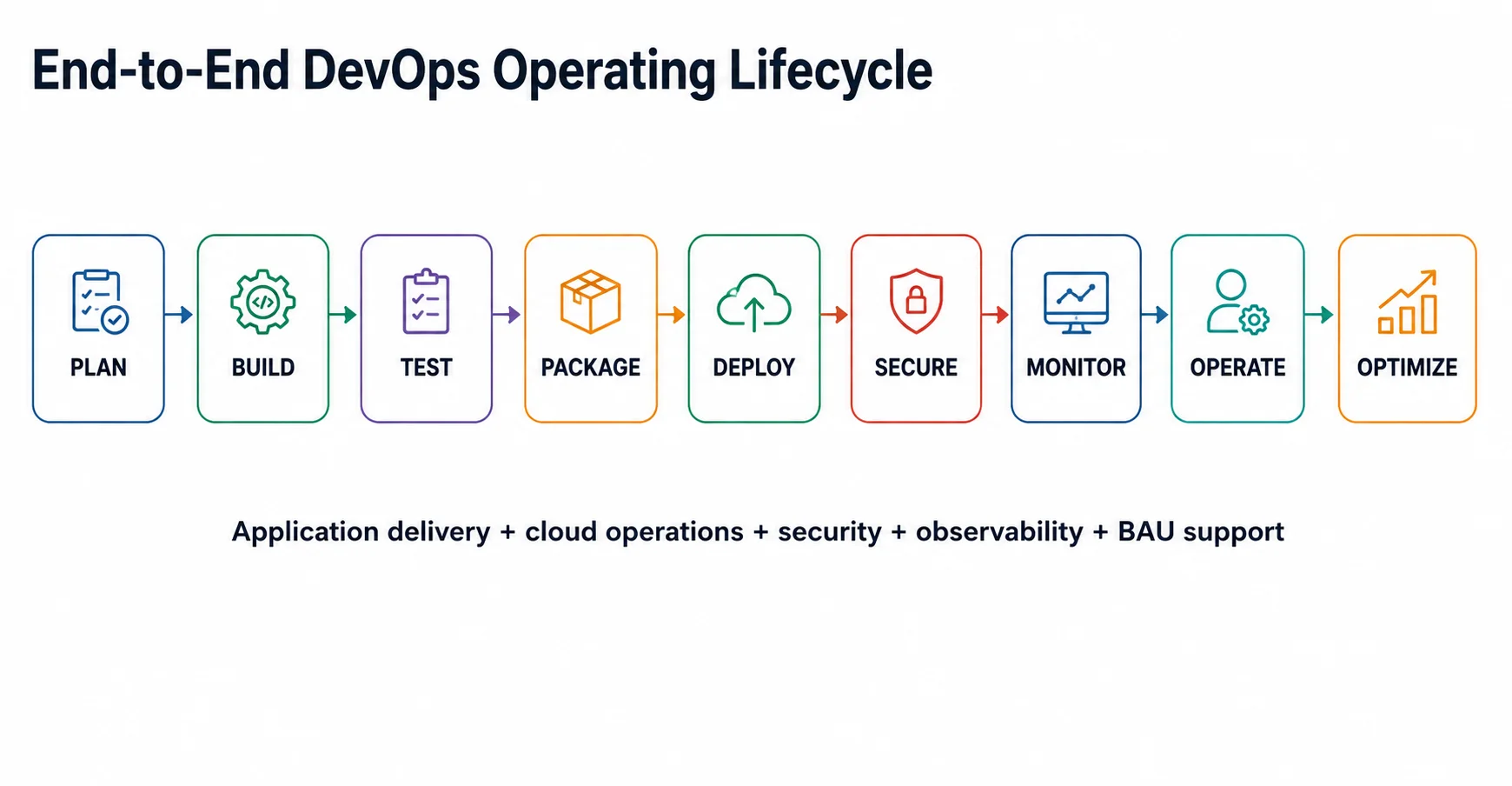
The client operates an enterprise application landscape of approximately 50 applications across multiple technology stacks, AWS accounts and environments. We established an end-to-end AWS DevOps capability covering CI/CD, cloud infrastructure operations, security, monitoring, release management, incident support, BAU operations and continuous improvement.
The transformation was designed around a practical principle: standardize the operating model and automate repeatable activities while retaining fit-for-purpose deployment mechanisms for each application architecture.
Client Landscape
Client Landscape
- Applications
- Approximately 50
- Technologies
- .NET, Sitecore CMS, Node.js, React, MuleSoft, AWS Lambda, Angular JS, VueJS, Power BI, Tableau, AWS RDS, Redis, AWS Cognito, Secrets Manager, S3, SES, SQS, ECS, EC2, ECR, Docker, SSIS, Cloudflare, Document DB, SAM, API Gateway, CloudFront
- Environments
- DEV, QA, PERF, UAT, PROD
- AWS Accounts
- Separate non-production and production account boundaries
- CI/CD Platform
- Jenkins with technology-specific build/deployment agents
- Deployment
- AWS Code Deploy, Lambda deployment, MS Deploy, MuleSoft deployment and frontend artifact deployment
The Challenge
The Challenge
- Different application technologies required different build, packaging and deployment mechanisms.
- Applications had to be promoted across DEV, QA, PERF, UAT and PROD with environment-specific configuration and controls.
- Separate AWS account boundaries for non-production and production increased the need for controlled access and deployment governance.
- Repetitive deployment and operational tasks created opportunities for automation and standardization.
- Sitecore CMS required Windows-based tooling and MSDeploy, while Linux workloads could use AWS CodeDeploy.
- Production support required coordinated troubleshooting across application, infrastructure, network, IAM and deployment layers.
- Security, vulnerability remediation, monitoring and operational resilience needed to be embedded into the DevOps operating model.
Before the Transformation
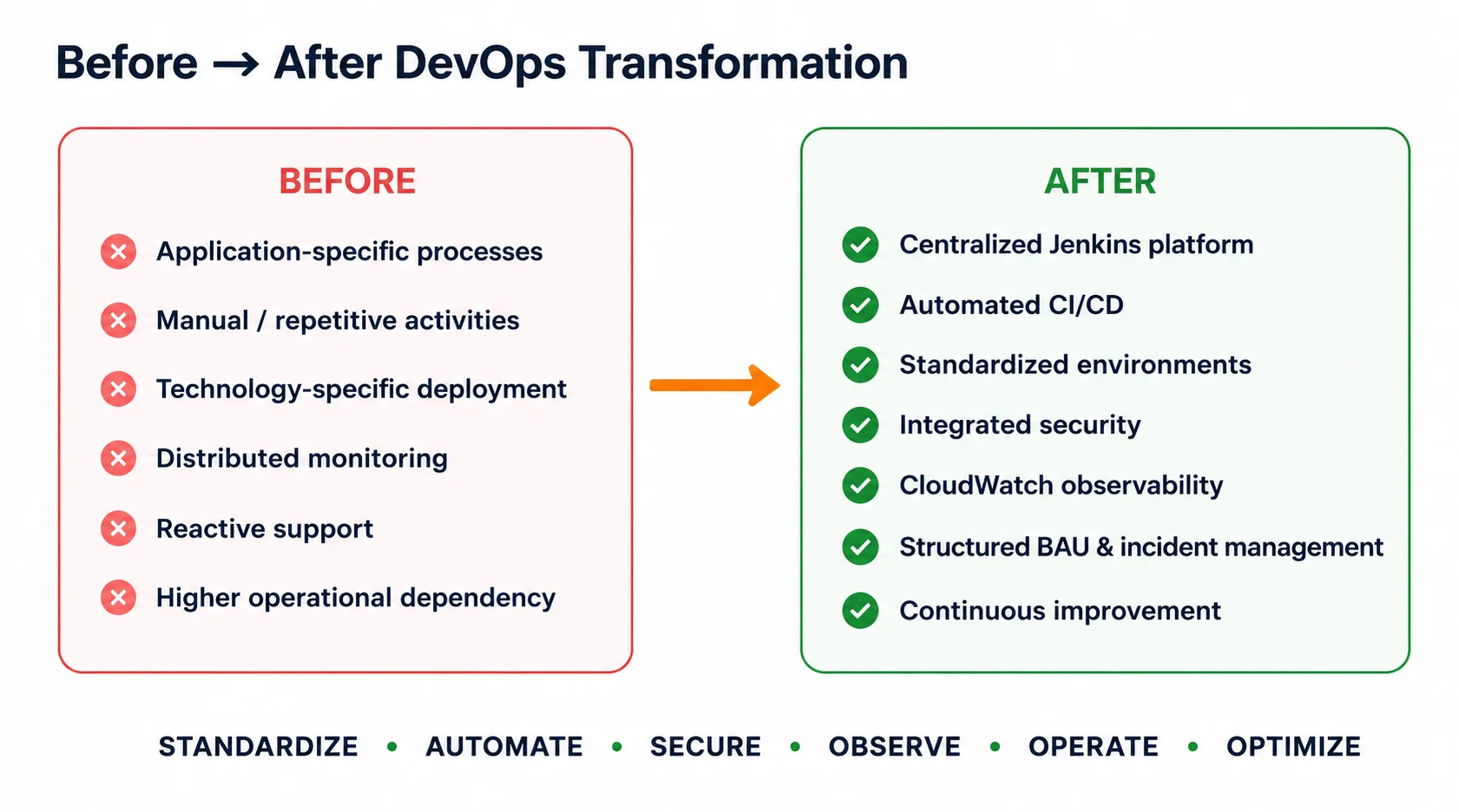
The key issue was not simply that everything was manual; rather, delivery and operations were fragmented across technologies, environments and teams. The transformation therefore focused on standardization, automation, governance and operational visibility.
YenDigital’s Transformation Strategy
YenDigital’s Transformation Strategy
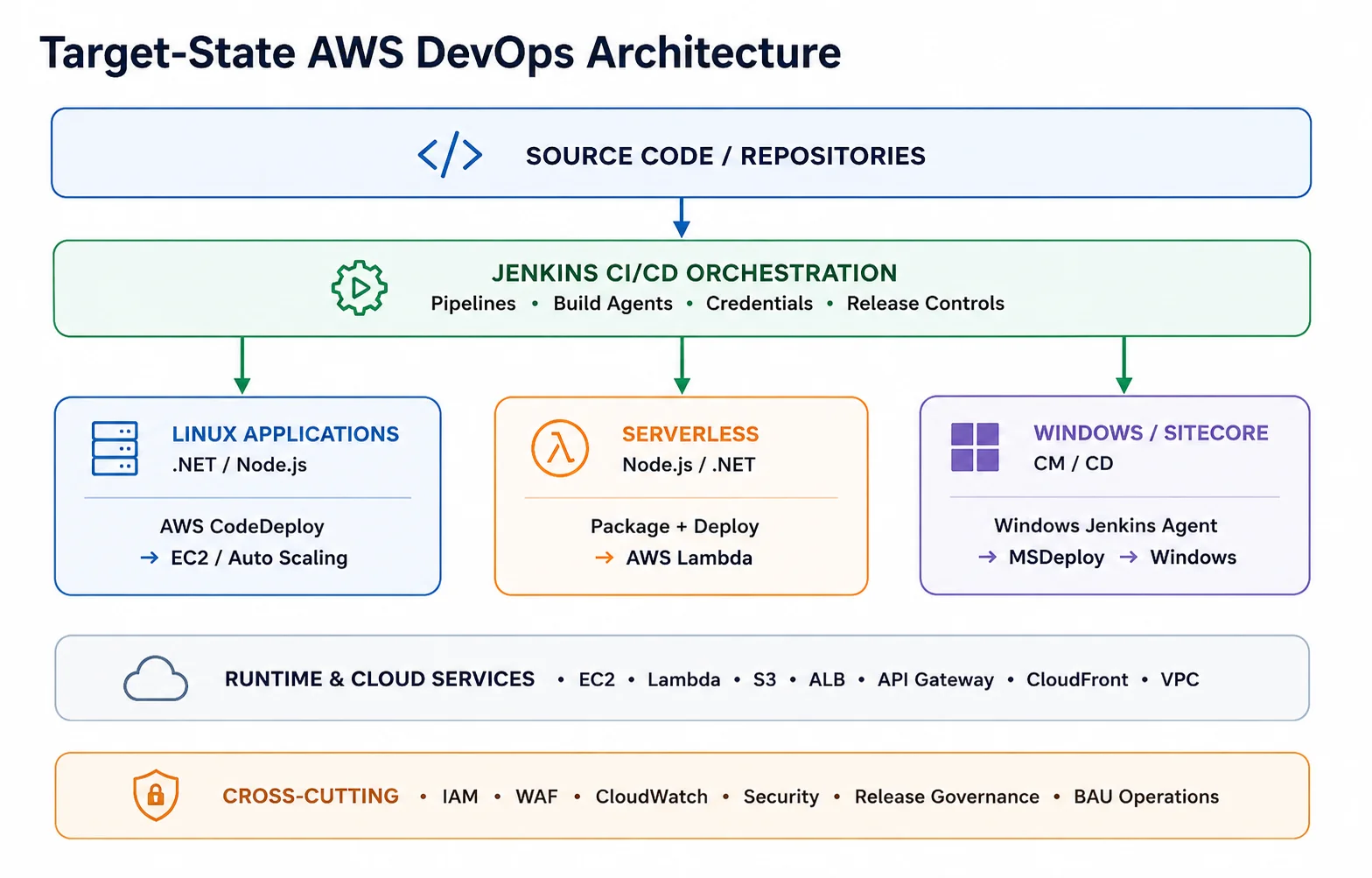
The transformation established a centralized DevOps orchestration layer with technology-specific deployment paths. Jenkins became the central automation and release orchestration platform, while AWS services and Windows tooling were used according to workload requirements.
Target-State Architecture
Target-State Architecture
CI/CD & Release Automation
A centralized Jenkins platform manages application build and deployment pipelines across the application portfolio. Standard stages include source checkout, dependency installation, build, testing, packaging, artifact creation, environment selection, deployment and post-deployment validation.
| Application type | Build / orchestration | Deployment mechanism | Target |
|---|---|---|---|
| .NET / Node.js on Linux | Jenkins | AWS Code Deploy |
Linux EC2 / Auto Scaling |
| AWS Lambda |
Jenkins |
Package + Lambda deployment | AWS Lambda |
| Enterprise CMS | Jenkins Windows Agent |
MSDeploy | Windows servers |
| MuleSoft | Jenkins + Maven |
MuleSoft deployment |
Mule runtime / client platform |
| React |
Jenkins + NPM | Build + artifact deployment |
Web hosting platform |
Linux EC2 Deployment
Linux EC2 Deployment
For .NET and Node.js applications deployed on Linux EC2, Jenkins performs the build and packaging activities and invokes AWS CodeDeploy for controlled deployment to target EC2 instances or Auto Scaling environments. This separates CI orchestration from deployment lifecycle management.
- Source checkout and dependency installation
- Build and unit-test execution
- Artifact/package creation
- AWS CodeDeploy deployment
- Deployment lifecycle monitoring
- Post-deployment validation
AWS Lambda Deployment
AWS Lambda Deployment
For serverless .NET and Node.js workloads, Jenkins automates the build, test, package and Lambda deployment lifecycle. This removes repetitive manual packaging and provides consistent release traceability.
Sitecore CM/CD Deployment
Sitecore CM/CD Deployment
Sitecore applications require Windows-specific deployment tooling. A dedicated Windows Jenkins agent is configured to build and deploy Sitecore CM and CD applications using MS Deploy. This allows Sitecore to remain part of the same centralized CI/CD operating model without forcing it into a Linux deployment pattern.
MuleSoft & React CI/CD
MuleSoft & React CI/CD
MuleSoft applications are integrated into Jenkins using Maven-based build and packaging workflows followed by the appropriate MuleSoft deployment mechanism. React applications use Jenkins and NPM to produce the frontend build artifact and automate the subsequent deployment process.
Environment & Multi-Account Strategy
Environment & Multi-Account Strategy
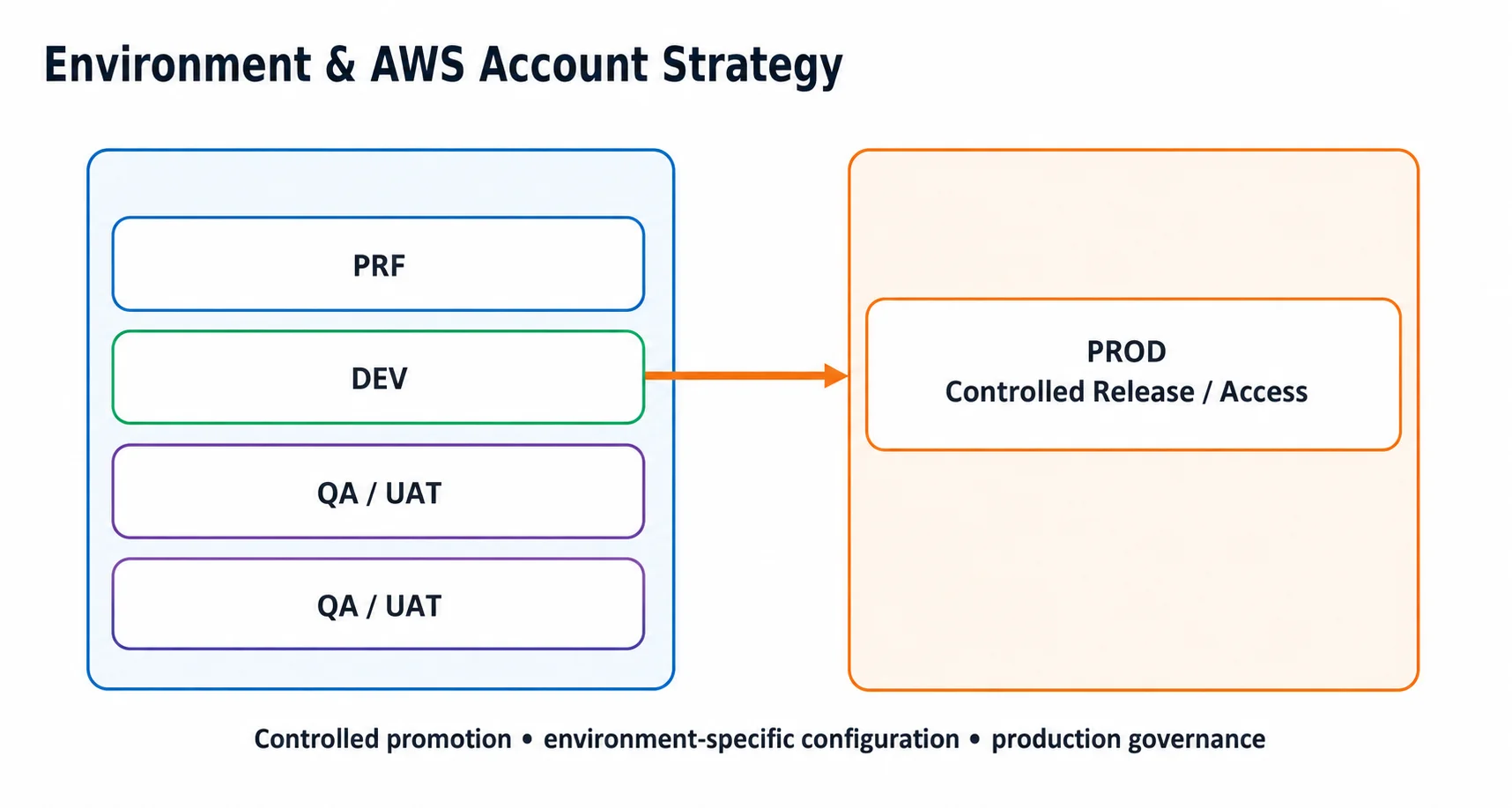
The operating model supports controlled application promotion across PRF, DEV, QA, UAT and PROD. Separate AWS accounts are maintained for non-production and production workloads, providing an additional security and governance boundary.
- Environment-specific configuration and deployment controls
- Controlled production access
- Release traceability
- Promotion of validated application artifacts
- Separation of non-production and production operational responsibilities
AWS Cloud Infrastructure Operations
AWS Cloud Infrastructure Operations
The DevOps scope extends beyond pipelines into day-to-day AWS cloud operations.
| Capability | Typical activities |
|---|---|
| Compute | EC2, Lambda, Auto Scaling, instance configuration and troubleshooting |
| Networking | VPC, security groups, load balancers, connectivity and DNS |
| Application platform |
API Gateway, S3, CloudFront and application integrations |
| Identity | IAM roles, policies, permissions and access troubleshooting |
| Monitoring | CloudWatch logs, metrics, alarms and operational dashboards |
| Deployment platform | Code Deploy, deployment groups, agents and lifecycle troubleshooting |
| Resilience | Scaling, availability, backup/recovery support and operational validation |
Infrastructure & Configuration Management
Infrastructure & Configuration Management
- Provisioning and configuration of application infrastructure.
- Security group and network access management.
- IAM role and policy configuration.
- Load balancer and Auto Scaling configuration.
- Application and environment-specific configuration management.
- DNS, S3, CloudFront, API Gateway and Lambda configuration.
- Increasing use of infrastructure automation and repeatable operational scripts where applicable.
Security & DevSecOps Operations
Security & DevSecOps Operations
Security is treated as a continuous operational responsibility rather than a one-time project activity.
| Security area | Activities |
|---|---|
| Identity & access | IAM roles, policies, least privilege and access reviews |
| Network security |
VPC, security groups and controlled network access |
| Application security | API Gateway controls, WAF and edge protection |
| Vulnerability management |
Dependency, package, runtime and infrastructure remediation |
| Cloud hardening |
Public exposure analysis, configuration review and remediation |
| Production security |
Controlled access and environment separation |
Monitoring & Observability
Monitoring & Observability
The DevOps team provides operational visibility across infrastructure, applications and deployments using CloudWatch and application-specific logging.
- EC2 health and resource utilization
- Lambda execution and errors
- API Gateway activity and errors
- Load balancer target health
- Application and deployment logs
- CloudWatch metrics, alarms and events
- Post-deployment monitoring and validation
Incident & Problem Management
Incident & Problem Management
Production and non-production incidents are handled through a structured operational lifecycle:
Detect → Analyze → Investigate → Remediate → Validate → Root Cause Analysis → Prevent Recurrence
- Application and infrastructure log investigation
- IAM and permission troubleshooting
- Network and connectivity analysis
- Deployment failure investigation
- AWS service troubleshooting
- Root cause analysis and preventive improvements
Release & Change Management
Release & Change Management
- Release preparation and deployment planning
- Build/version traceability
- Environment promotion
- Production deployment controls
- Deployment validation
- Rollback support where applicable
- Post-release monitoring
- Change implementation and verification
BAU DevOps Operations
BAU DevOps Operations
The DevOps team operates as an extension of the client’s engineering organization and provides ongoing support across the application and cloud lifecycle.
| BAU area | Examples |
|---|---|
| Daily operations |
Infrastructure health, access, configuration and deployment support |
| Release support | Environment releases, production deployments and validation |
| Incident support |
Troubleshooting, service recovery and RCA |
| Security | Vulnerability remediation, IAM, WAF and hardening |
| Monitoring | Logs, metrics, alarms and application health |
| Platform maintenance |
Jenkins, agents, deployment tooling and runtime upgrades |
| Continuous improvement |
Automation, modernization, reliability and cost optimization |
Before vs. After – Operating Model
Before vs. After – Operating Model
| Capability | Before | After |
|---|---|---|
| Delivery | Application-specific procedures |
Centralized Jenkins-based CI/CD |
| Deployment | Different mechanisms and manual/repetitive steps |
Automated, technology-specific deployment paths |
| Environment management |
Complex application-specific processes | Structured AWS cloud operations |
| Security | Finding/remediation driven |
Integrated DevSecOps activities |
| Monitoring | Distributed operational information |
Structured CloudWatch and application observability |
| Incidents | Application-specific troubleshooting |
Structured incident and RCA lifecycle |
| BAU | Reactive support |
Managed DevOps operating model |
| Automation | Selected repetitive tasks |
Continuous automation program |
| Scalability | Operational complexity increased with portfolio |
Common model scalable across applications and accounts |
Business & Technical Outcomes
Business & Technical Outcomes
- Standardized delivery and operational practices across approximately 50 applications.
- Automated build and deployment processes across multiple technology stacks.
- Improved repeatability and traceability of application releases.
- Reduced dependency on manual and application-specific deployment procedures.
- Established a common operating model across PRF, DEV, QA, UAT and PROD.
- Improved separation and governance between non-production and production AWS accounts.
- Integrated security, vulnerability remediation and cloud-hardening activities into DevOps operations.
- Improved monitoring and troubleshooting through centralized operational visibility.
- Created a scalable model for onboarding additional applications and AWS workloads.
- Established continuous improvement as part of BAU DevOps operations.
Recommended Success Metrics
Recommended Success Metrics
For a final client presentation or published case study, actual baseline and post-transformation measurements should be inserted where available.
| KPI | Measurement |
|---|---|
| Deployment Frequency | Number of deployments per application / month |
| Lead Time for Change |
Commit or approved change to production |
| Change Failure Rate |
Failed, rolled-back or hotfix releases / total releases |
| MTTR | Average time from incident detection to service restoration |
| Automation Coverage |
Automated deployments / total deployments |
| Pipeline Success Rate | Successful pipeline executions / total executions |
| Vulnerability SLA |
Findings remediated within agreed SLA |
| Infrastructure Availability |
Availability of critical workloads |
| Cost Optimization |
Savings / avoided spend from optimization initiatives |
DevOps Maturity Journey
DevOps Maturity Journey
- 1. Manual / Fragmented
- Application-specific build, deployment and operational processes
- 2. Automated CI/CD
- Automated build and deployment for selected workloads
- 3. Standardized DevOps
- Common pipeline and environment patterns
- 4. Secure & Observable
- Integrated security, monitoring and operational governance
- 5. Continuous Optimization
- Automation, modernization, reliability and cost optimization
Our Role as the DevOps Partner
Our Role as the DevOps Partner
The engagement extends beyond Jenkins administration or CI/CD implementation. The team acts as an end-to-end AWS DevOps partner across:
- Cloud engineering and AWS infrastructure operations
- CI/CD engineering and release automation
- Security and vulnerability remediation
- Monitoring and observability
- Incident and problem management
- Environment and release management
- Application operations and troubleshooting
- Operational automation
- Performance, reliability and cost optimization
- Continuous improvement and platform modernization
Conclusion
Conclusion
The transformation established a scalable AWS DevOps operating model for a diverse application landscape of approximately 50 applications, multiple technologies, multiple AWS accounts and five environments.
The resulting capability combines CI/CD automation, AWS cloud operations, infrastructure management, security, monitoring, release management, incident support, BAU operations and continuous improvement.
The core transformation can be summarized as:
BUILD → DEPLOY → SECURE → MONITOR → OPERATE → OPTIMIZE
The objective is not simply to automate deployments, but to provide a reliable, secure and scalable engineering platform that enables application teams to deliver business value faster while the DevOps function provides the cloud and operational foundation.